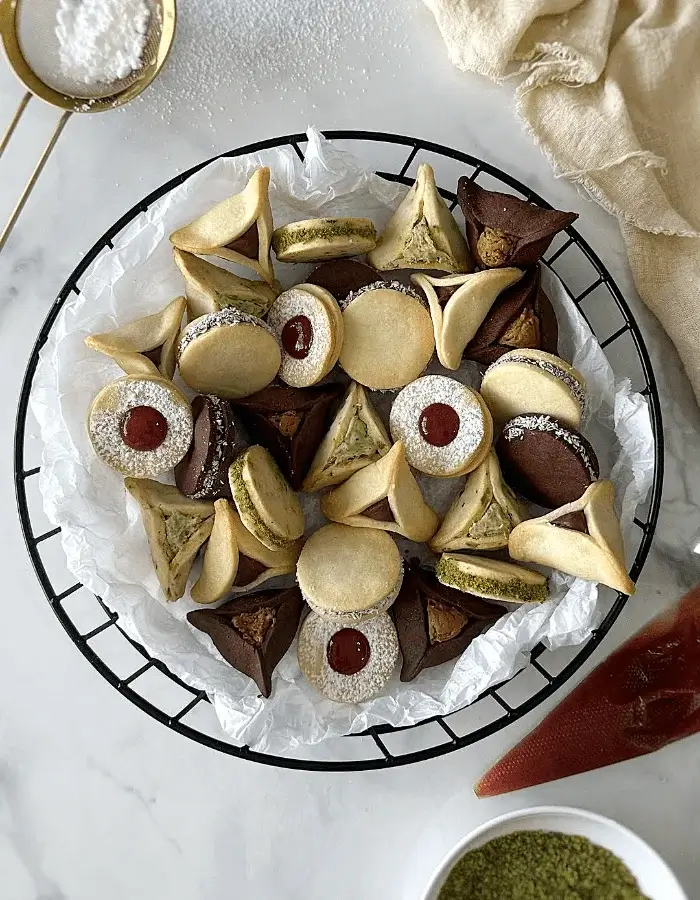
Melt-in-Your-Mouth Purim Cookies

Watch the Full Step-by-Step
- Mixing bowls
- Round cutter
- Kitchen scale
INGREDIENTS
Dough:
- 7 ounces/200 grams unsalted butter, softened
- ⅓ cup powdered sugar
- 1 large egg
- 2 cups/260 grams all-purpose flour
- 1 cup/130 grams cornstarch
Add-ins:
- 2 tablespoons pistachios, chopped
- 2 tablespoons cocoa powder
- Hamantaschen fillings:
- Chocolate spread
- Biscoff spread
Pistachio filling:
- 5 ounces/150 grams white chocolate, melted
- ½ cup + 1 tablespoon pistachios, ground
Sandwich cookie fillings:
- Dulce de leche
- Strawberry jam

INSTRUCTIONS
- Cream butter and sugar until smooth. Add the egg and mix. Sift in flour and cornstarch; knead until smooth. Chill for 10 minutes.
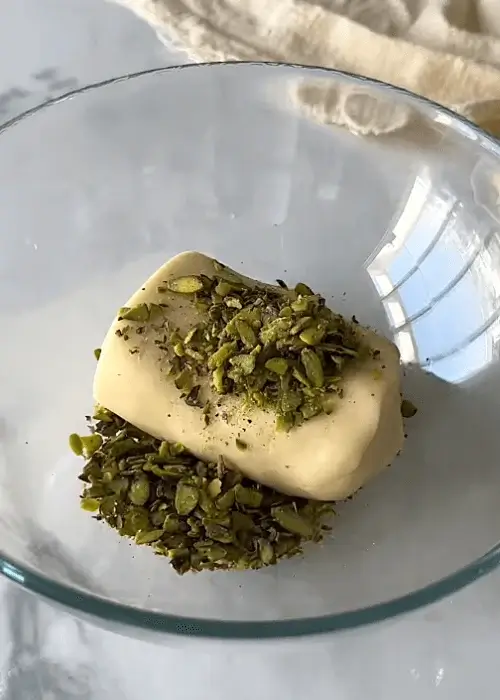
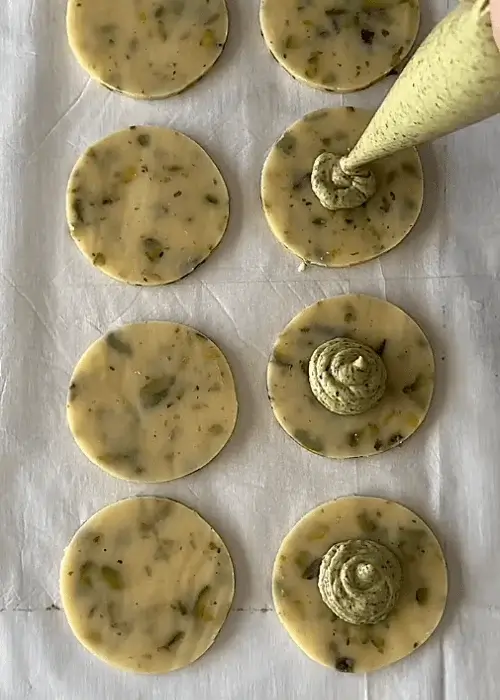
- Divide dough into three portions. Add cocoa to one and pistachios to another, leaving the third plain. Roll each parchment to 1/8-inch thickness. Cut circles with a round cutter.
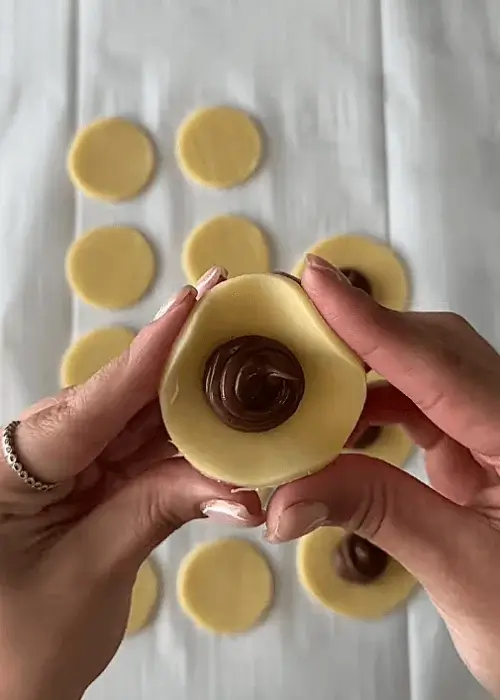
- Place 1 teaspoon filling in the center of each circle. Fold into hamantaschen and pinch edges firmly. Arrange on parchment-lined baking sheets. Bake at 350°F/180°C for 12–14 minutes.
- Bake flat cookies on the same sheet for 10 minutes. Transfer to wire racks to cool. Fill sandwich cookies and decorate as desired.
FAQ
How do I keep hamantaschen from opening while baking?
When making Purim cookies, it is essential to chill the dough before shaping and, if the kitchen is warm, briefly chill the shaped cookies before baking. Cold dough firms up the butter, which slows spreading and helps maintain structure. Use no more than 1 teaspoon of filling per 3-inch round; overfilling creates steam pressure that forces the seams apart.
To shape, fold the dough firmly over the filling and pinch the corners tightly to create distinct seams rather than simply folding edges inward. Press the seams together with deliberate pressure to create adhesion in the dough layers. Avoid overly wet fillings, as excess moisture weakens structure. Baking at a consistent 350°F/180°C also ensures proper set before excessive spreading occurs.
Can I freeze the dough or baked Purim cookies?
Yes, both the dough and baked Purim cookies freeze well if handled properly. For dough, wrap each portion tightly in plastic wrap and place in an airtight container or freezer bag. Freeze for up to 2 months. Thaw overnight in the refrigerator before rolling. Slight condensation may form, so allow the dough to rest at cool room temperature for 10 to 15 minutes before working to prevent cracking.
Baked cookies can also be frozen, preferably unfilled if making sandwich cookies. Cool completely before freezing to prevent trapped steam, which causes sogginess. Store in airtight containers with parchment between layers. Thaw at room temperature, uncovered, to maintain texture. Avoid freezing jam-filled cookies longer than one month, as fruit fillings can weep after thawing.
Why is cornstarch used in this dough for Purim cookies?
Cornstarch reduces gluten development by diluting the protein content of the flour, resulting in a softer, more tender crumb. In Purim cookies, especially those intended to be melt-in-your-mouth, cornstarch creates a delicate, sandy texture similar to shortbread. Because cornstarch contains no gluten-forming proteins, it interrupts the flour’s ability to form elastic structure, limiting chewiness and promoting tenderness.
Additionally, cornstarch absorbs moisture differently than flour, which helps create a lighter mouthfeel once baked. The balance between flour and cornstarch is important; too much cornstarch can make cookies fragile and crumbly, while too little will result in a firmer texture. In this formulation, the ratio provides enough structure to hold hamantaschen shape while maintaining a soft bite.
What fillings work best for Purim cookies without leaking?
Thick, stable fillings perform best in Purim cookies. Chocolate spread, Biscoff spread, dulce de leche, and dense nut pastes hold their shape under heat and do not release excessive moisture. The key factor is viscosity: fillings should be thick enough to mound slightly without spreading. If using jam, choose high-pectin varieties and avoid thin preserves. If necessary, simmer jam briefly to reduce excess liquid before cooling completely and using.
White chocolate–based fillings, such as pistachio cream made from melted white chocolate and ground nuts, are particularly stable because cocoa butter solidifies as it cools. Avoid fresh fruit or custard-style fillings unless fully pre-cooked and thickened. Excess moisture creates steam during baking, which weakens the dough seams and leads to leaking or splitting.
Can I make gluten-free Purim cookies?
Yes, but the flour blend must contain a stabilizer such as xanthan gum to replicate gluten’s binding properties. Use a 1:1 gluten-free baking flour designed for cookies and pastries. Because gluten-free blends vary in absorbency, the dough may feel slightly softer or more fragile. Chilling is especially important to firm the structure before shaping.
Gluten-free dough can be more delicate when folding hamantaschen, so handle gently and pinch seams firmly. If cracks appear, patch with small pieces of dough. Baking time remains similar, but monitor closely, as gluten-free flours can brown differently.
How thin should I roll the dough for Purim cookies?
Roll to approximately 1/8-inch thickness. This thickness provides the correct balance between tenderness and stability. If the dough is rolled thinner than 1/8 inch, the hamantaschen walls may collapse or tear when folded, particularly once filled. Thin dough also bakes faster and may brown excessively before the center sets. If rolled thicker than 3/16 inch, the cookies can become dense and underbaked in the folds while the exterior appears done.
Uneven thickness leads to inconsistent baking, where thinner edges brown faster and thicker centers remain pale. Use parchment paper on both sides to prevent sticking and reduce the need for excess flour, which can toughen the dough. After rolling, briefly chill the sheet if the butter feels soft.
Why are my Purim cookies dry?
Dry texture typically results from overbaking, excessive flour incorporation, or overworking the dough. Because Purim cookies are designed to be tender and delicate, even two extra minutes in the oven can remove enough moisture to create a crumbly texture. The cookies should be set but pale, with minimal browning. Residual heat continues to cook them slightly after removal from the oven.
Another common cause is packing flour into measuring cups rather than spooning and leveling, which increases total flour weight. Excess flour shifts the fat-to-flour ratio and produces dryness. Overmixing can also develop gluten, leading to a firmer bite rather than a melt-in-the-mouth finish. Mix only until the dough is smooth and cohesive.
Why does my dough crack when I fold the hamantaschen?
Cracking typically occurs when the dough is too cold, too dry, or rolled too thin. If the dough has just come from the refrigerator and feels firm, allow it to sit at room temperature for several minutes until pliable. Cold butter-based dough lacks flexibility and can split when folded.
Excess flour during rolling also dries the surface and encourages cracking. Roll between parchment to minimize added flour. If cracks form at the folds, gently press and smooth them with your fingers before baking. Maintaining 1/8-inch thickness provides sufficient flexibility for shaping.
Can I make these Purim cookies dairy-free?
Yes, but substitutions must preserve fat structure. Replace butter with a high-fat, plant-based baking block rather than soft tub margarine. A product with at least 75 to 80 percent fat is necessary to mimic butter’s structure and melting properties. Lower-fat substitutes contain excess water, which increases spread and weakens seams in hamantaschen.
Because butter contributes both flavor and structure, dairy-free versions may taste slightly less rich. Adding a small pinch of salt can enhance flavor depth. The remaining ingredients generally require no modification. Chill time may need to be slightly extended if the plant-based fat softens more quickly at room temperature.
How do I store Purim cookies to keep them fresh?
Store unfilled cookies in an airtight container at room temperature for up to five days. Ensure they are completely cooled before sealing, as residual warmth creates condensation that softens texture. Layer with parchment paper to prevent sticking. Hamantaschen filled with stable spreads such as chocolate or Biscoff store well at room temperature, provided the environment is cool and dry.
Sandwich cookies filled with jam or dulce de leche should be stored in a single layer or lightly separated with parchment to avoid smearing. Avoid refrigeration unless necessary, as cold air can dry the cookies and alter texture. If refrigeration is required due to warm climate conditions, bring Purim cookies back to room temperature before serving to restore tenderness and flavor clarity.
Can I use whole wheat flour in Purim cookies?
Because whole wheat contains bran and germ, it has higher fiber content and absorbs more moisture than all-purpose flour. Substituting it fully will produce a denser, slightly drier Purim cookies dough with a more pronounced nutty flavor. To maintain tenderness, replace no more than 25 to 50 percent of the all-purpose flour with whole wheat flour.
You may also need to add 1 to 2 teaspoons of milk or water if the dough feels crumbly, since whole wheat absorbs liquid more aggressively. Allowing the dough to rest for 20 to 30 minutes before rolling improves hydration and reduces cracking.

Can I make Purim cookies without a stand mixer?
Purim cookies can be made entirely by hand with a mixing bowl and a sturdy spatula or wooden spoon. Because the dough is short and butter-based, it does not require aeration or extended creaming. Simply mash the softened butter and powdered sugar together until smooth and cohesive, then mix in the egg until fully incorporated. Sift in the dry ingredients and knead gently just until the dough forms.
Avoid vigorous mixing once the flour is added, as overworking develops gluten and reduces tenderness. If the butter is properly softened, hand mixing is efficient and produces the same texture as a mixer. In fact, manual mixing offers greater control and reduces the risk of overmixing.
Why did my Purim cookies spread too much in the oven?
Excess spreading is typically caused by warm dough, insufficient flour structure, or inaccurate oven temperature. Because Purim cookies rely on butter for tenderness, softened butter must be re-chilled before baking. If the dough feels soft or sticky when shaping, refrigerate the formed cookies for 10 to 15 minutes before baking. Cold butter melts more slowly, preserving shape.
Another factor is flour measurement. Under-measuring flour reduces structure, allowing cookies to flatten. Use proper measuring technique or weigh flour for accuracy. Additionally, verify oven calibration; a lower-than-indicated temperature delays structure setting and encourages spread. Baking sheets should be cool before placing new batches, as residual heat softens the dough prematurely.
How far in advance can I assemble filled Purim cookies for gifting?
Fully assembled Purim cookies can be prepared 1 to 2 days before gifting, depending on filling type. Stable fillings such as chocolate spread, Biscoff, or white chocolate pistachio cream maintain texture and structure for several days at room temperature. Jam-filled sandwich cookies may soften slightly as moisture migrates into the cookie layers, so assemble them no more than 24 hours in advance for optimal texture.
Store finished cookies in airtight containers at cool room temperature, layered with parchment to prevent sticking. Avoid humid environments, as moisture reduces crispness and weakens structure. If gifting in boxes, ensure cookies are completely cooled before packing to prevent condensation.

How do I know when Purim cookies are properly baked?
Purim cookies are done when the edges are set and the bottoms are lightly golden, while the tops remain pale. These cookies should not deeply brown, as excessive color indicates moisture loss and reduced tenderness. Baking time generally falls between 10 and 14 minutes depending on thickness and oven performance.
To check doneness, gently lift one cookie with a spatula and inspect the underside. It should be lightly golden but not dark brown. The surface should feel dry to the touch without appearing glossy or wet. Remember that carryover heat continues baking after removal from the oven, so slightly underbaking is preferable to overbaking. Cooling on wire racks allows steam to escape and prevents sogginess while preserving texture.
Can I prepare the dough a day in advance?
Preparing the dough in advance can improve both flavor and handling. After mixing, wrap each portion tightly in plastic wrap and refrigerate for up to 24 hours. Resting allows the flour to fully hydrate and the butter to firm, producing a smoother, easier-to-roll dough. When ready to use, let the dough sit at cool room temperature for 10 to 15 minutes until pliable but still firm.
Do not attempt to roll the dough directly from the refrigerator if it is fully hardened, as cracking may occur. Conversely, avoid letting it soften excessively, which increases sticking and spreading.
Why are the bottoms of my Purim cookies browning too quickly?
Excessive bottom browning is usually caused by dark baking sheets, thin pans, or rack placement too close to the lower heating element. Dark metal absorbs more heat and accelerates caramelization. For even baking, use light-colored, heavy-gauge baking sheets and position racks in the center of the oven.
Another contributing factor is prolonged preheating with empty pans inside the oven, which overheats the metal before dough placement. Always place dough on cool, parchment-lined sheets. If bottoms continue to brown too quickly, double-stack baking sheets to create insulation or reduce oven temperature slightly by 10 to 15 degrees.