Molten Center Kinder Cookies
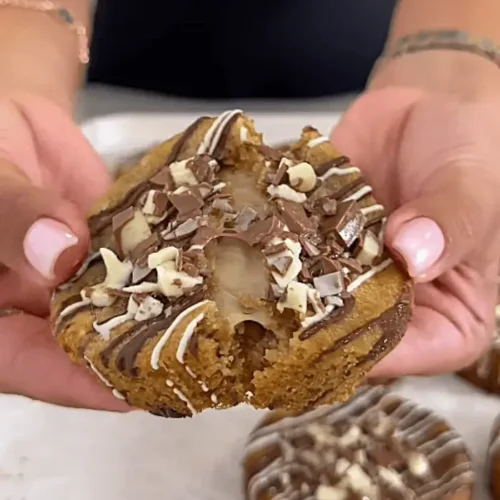
Watch the Full Step-by-Step
- Mixing bowls
- Ice cream scoop
- Kitchen scale
- Silicone mold
- Baking sheet
- Round pastry rings, 8 cm/3 inches optional
INGREDIENTS
- 1 cup/250 grams Kinder spread or Nutella
- 4 ounces/115 grams white or milk chocolate, melted
- 2 ounces/60 grams Kinder chocolate, finely chopped
Dough:
- 7 ounces/200 grams unsalted butter, softened
- ¾ cup granulated sugar
- ½ cup light brown sugar
- 1 large egg
- 1 teaspoon vanilla bean paste or extract, optional
- 2 cups/280 grams all-purpose flour
- ½ teaspoon/3 grams baking soda
- ½ teaspoon/2 grams baking powder
- 7 ounces/200 grams Kinder chocolate, finely chopped

INSTRUCTIONS
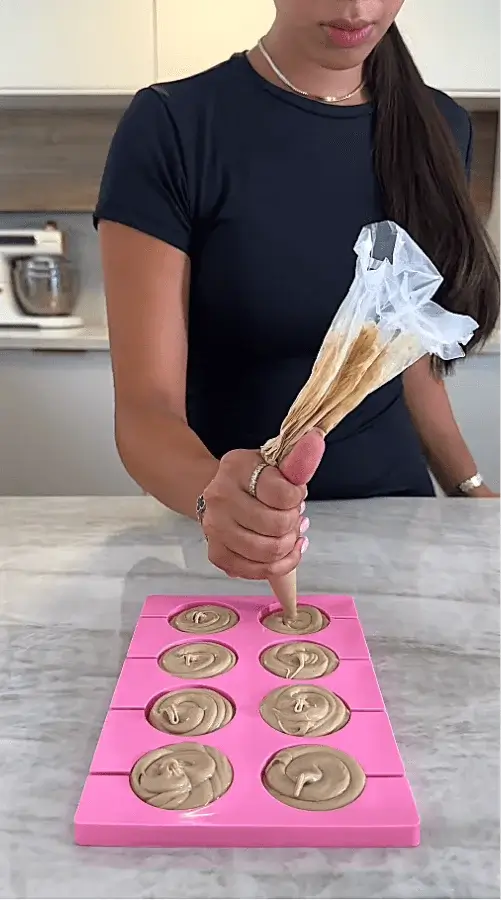
- Prepare the filling: Line a small tray with parchment paper or use a silicone mold. Pipe twelve 1-tablespoon portions of Kinder spread or Nutella and freeze until completely firm, at least 30 minutes. Skip this step if making unfilled cookies.
- Make the dough: In a large bowl, cream the butter, granulated sugar, and brown sugar until smooth and pale. Add the egg and vanilla and mix until fully incorporated. Add the flour, baking soda, and baking powder and mix just until a cohesive dough forms. Fold in the chopped Kinder chocolate. Cover and refrigerate the dough for 30 minutes to firm.
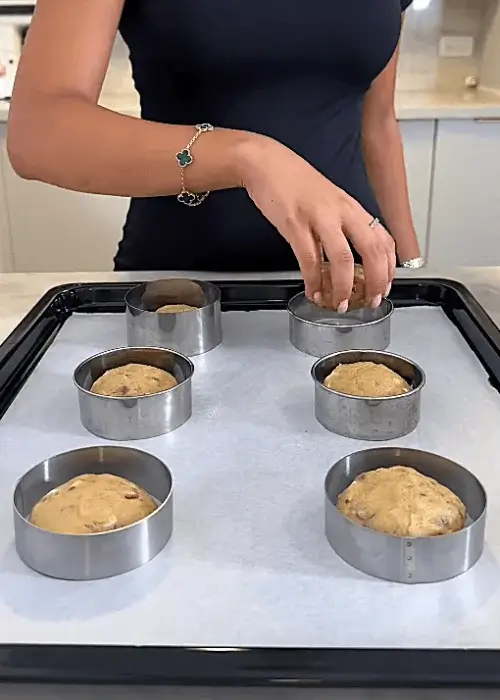
- Portion the dough into twelve equal balls, about 2 ounces/60 grams each. Press a frozen round of filling into the center of each portion and seal the dough completely around it. Arrange on a tray and freeze for 10 minutes.
- Heat the oven to 375°F/190°C. Line a baking sheet with parchment paper.
- Space the cookies well apart; for thick, uniform cookies, place an 8-centimeter/3-inch ring around each portion. Bake until the edges are set and lightly golden while the centers remain soft, 12 to 13 minutes.
- Let cool on the baking sheet until the cookies firm up, then transfer to a rack to cool completely. Finish with melted chocolate and chopped Kinder before serving.
FAQ
What makes Kinder cookies stay thick and not spread too much?
The structure of Kinder cookies depends on fat temperature, dough hydration, and chilling. Using softened but not melted butter ensures proper creaming with the sugars, which traps air and creates lift without making the dough greasy. Chilling the dough for at least 30 minutes solidifies the fat and hydrates the flour, which slows spread during baking and keeps Kinder cookies tall and thick.
Freezing the filled dough balls for 10 minutes before baking also stabilizes the center and prevents collapse. Proper flour measurement matters; too little flour causes spreading, while too much creates dry cookies. Baking on a cool sheet lined with parchment and using a pastry ring can further maintain structure and give Kinder cookies a bakery-style height and defined edges.
How do you keep the molten center inside from leaking?
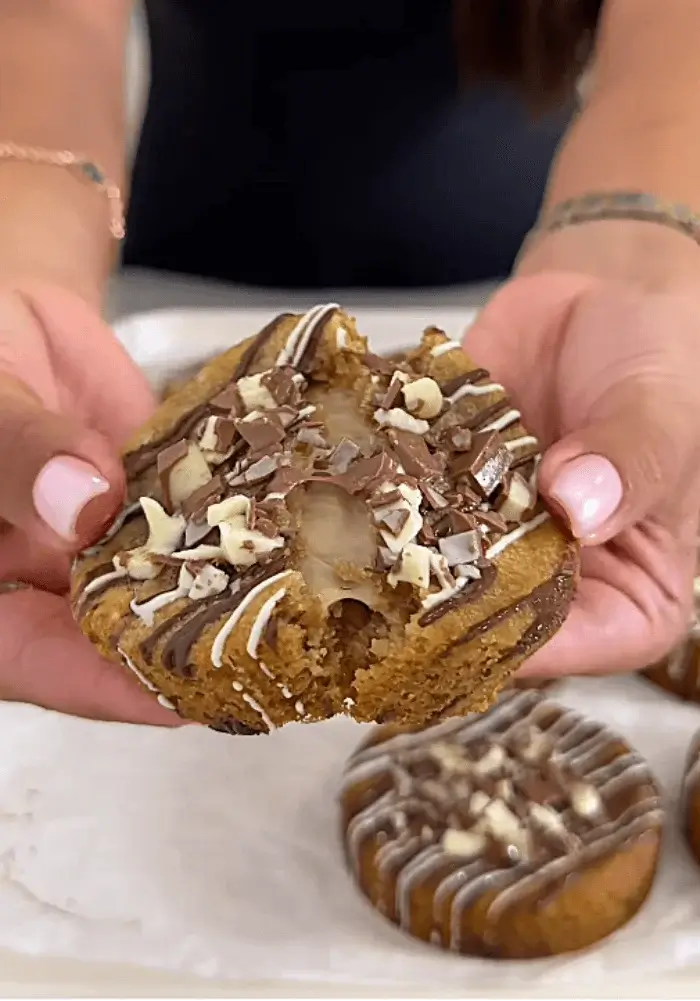
The molten center in Kinder cookies relies on freezing the filling until completely solid and sealing it thoroughly inside the dough. Piping the Kinder spread or Nutella into measured portions and freezing them for at least 30 minutes creates a stable core that holds its shape during assembly. When enclosing the filling, flatten the dough slightly, place the frozen center in the middle, and wrap the dough fully around it without thin spots or seams.
Any exposed filling will leak during baking. After sealing, freezing the dough balls for 10 minutes helps the outer dough firm up and bake evenly. Baking at the correct temperature, 375°F/190°C, ensures the cookie sets quickly on the outside while the center melts gradually, keeping the molten effect intact in Kinder cookies.
Can Kinder cookies be made ahead and frozen before baking?
Kinder cookies are well suited for make-ahead preparation and freezing. Once filled and shaped, the dough balls can be frozen solid and stored in an airtight container for up to one month. Freezing prevents the filling from seeping into the dough and helps maintain a defined molten center during baking.
When ready to bake, place the frozen dough directly onto a parchment-lined baking sheet and bake at 375°F/190°C, adding one to two extra minutes to the bake time. Avoid thawing, as this can soften the dough and lead to excess spread. You can also freeze the filling portions separately and assemble later.
What type of Kinder chocolate works best in Kinder cookies?
Standard Kinder chocolate bars or Kinder fingers are ideal for Kinder cookies because they contain a milk chocolate shell with a creamy milk filling that melts smoothly without becoming grainy. Finely chopping the bars ensures even distribution throughout the dough, creating pockets of melted chocolate in every bite. Avoid chocolate with excessive fillings or wafers, as these can alter texture and create uneven melting.
If Kinder bars are unavailable, a combination of milk chocolate and white chocolate can approximate the flavor profile, though the signature taste of Kinder cookies comes from the specific balance of cocoa and milk solids in authentic Kinder chocolate. Use fresh chocolate stored at cool room temperature, since heat exposure can cause fat bloom and affect melting performance in the finished cookies.
Why is chilling the dough important?
Resting the dough in the refrigerator for 30 minutes allows the flour to fully hydrate and the butter to resolidify, which improves dough cohesion and reduces spread. Hydrated flour forms a stronger gluten network, giving the cookies structure while still remaining tender.
Chilling also enhances flavor by allowing sugars to dissolve more evenly and interact with the fat, leading to better browning during baking. After filling, a brief freeze of the shaped dough balls ensures the molten center remains intact and prevents premature melting.
How do you know when Kinder cookies are fully baked but still soft inside?
Properly baked Kinder cookies should have set, lightly golden edges and a center that still looks slightly underbaked and soft. At 375°F/190°C, most batches bake in 12 to 13 minutes, depending on oven accuracy and dough temperature. The surface should appear matte rather than glossy, and the edges should hold their shape when gently nudged.
The cookies will continue to firm as they cool on the baking sheet, so removing them while the centers are still soft is essential for a chewy texture. Overbaking will fully set the center and reduce the molten effect. Allowing Kinder cookies to cool on the pan for several minutes helps stabilize the structure before transferring to a rack, ensuring they hold their shape while remaining tender inside.
Do Kinder cookies need a convection oven?
The cookies can be baked successfully in either a convection or conventional oven. The recipe temperature of 375°F/190°C works for a standard conventional oven and produces a crisp exterior with a soft center.
If using convection, reduce the temperature slightly to 350°F/175°C and monitor the cookies closely, as the fan circulation can bake them faster and set the edges more quickly. The key is to bake until the edges are lightly golden and the centers remain soft. Rotating the tray halfway through baking helps ensure even heat distribution.
Can you make the cookies without the molten center filling?
The cookies can be made without the molten filling by skipping the freezing and filling steps and baking the dough as standard chocolate-studded cookies. The chopped Kinder chocolate in the dough will still create pockets of melted chocolate and deliver the characteristic flavor.
If omitting the center, you may want to slightly flatten the dough balls before baking so they spread evenly. Bake time remains about 12 to 13 minutes at 375°F/190°C, though unfilled cookies may bake a minute faster. The result will be thick, chewy Kinder cookies with a uniform interior rather than a molten core.