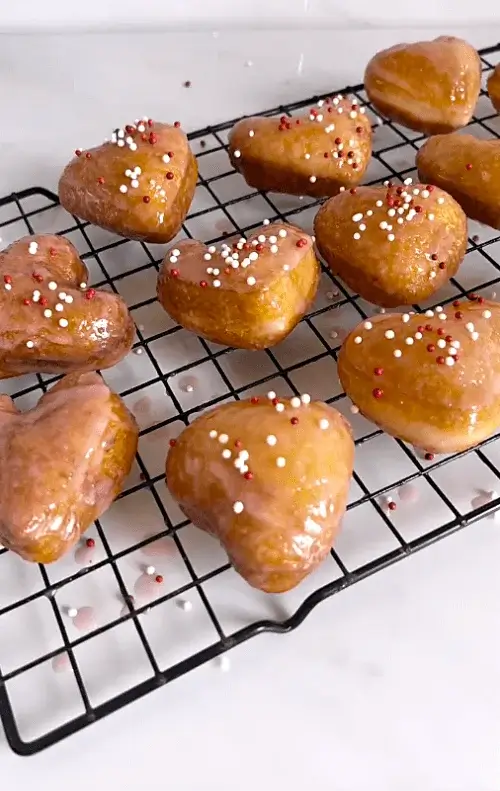
Mini Heart Donuts with Milk Glaze
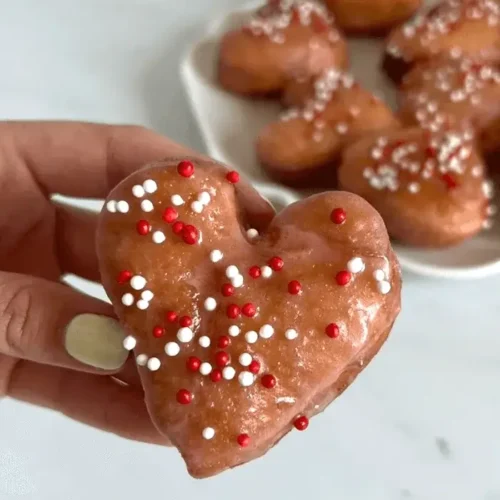
Watch the Full Step-by-Step
- Mixing bowls
- Kitchen scale
- Rolling Pin
- Heart-shaped cutters
- Bench scraper
- sheet pans
- Thermometer
- Wire rack
INGREDIENTS
- 3½ cups/490 grams all-purpose flour
- 1 tablespoon/20 grams fresh yeast or 2¼ teaspoons/7 grams active dry yeast
- ¼ cup granulated sugar
- 1 cup/235 grams whole milk, warm
- 1 large egg/50 grams
- 2 ounces/55 grams unsalted butter, melted
- ¼ teaspoon fine salt
- 1 tablespoon vodka, arak, or brandy
- Oil, for frying
Glaze:
- 1 cup powdered sugar
- 3 to 4 tablespoons milk
- Natural red food coloring, as desired

INSTRUCTIONS
- In a stand mixer fitted with a dough hook, combine the flour, yeast, and sugar. Add the milk and egg and mix on low speed until a rough dough forms. Add the melted butter and mix to incorporate. Add the salt and vodka and knead on medium speed until smooth and elastic, about 15 minutes. The dough will be soft and slightly sticky.
- Transfer to a lightly oiled bowl, cover, and let rise until doubled in size, about 1½ hours, or refrigerate overnight and bring to room temperature before shaping.
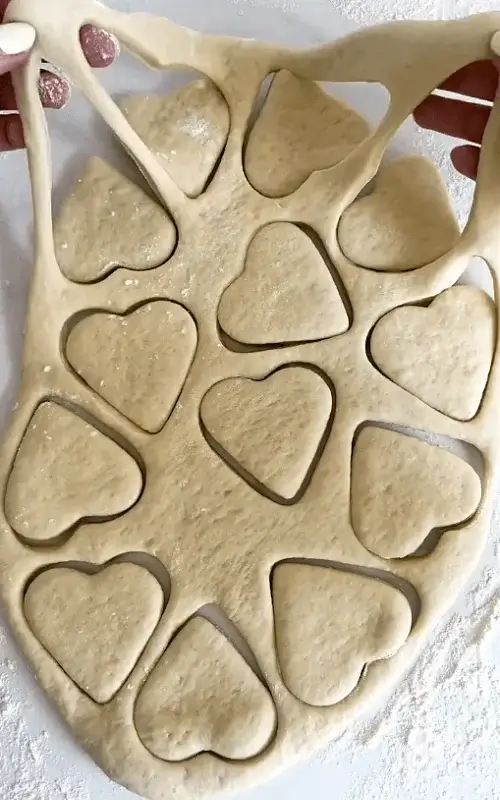
- Turn the dough onto a lightly floured surface and roll to ½ inch/1.25 cm to ¾ inch/2 cm thickness. Cut into heart shapes. Gather scraps, rest 10 minutes, reroll, and cut until all dough is used.
- Arrange on a parchment-lined sheet pan, spacing the donuts about 1 inch/2.5 cm apart. Cover loosely and let rise until slightly puffy, about 20 minutes.
- Meanwhile, heat 2 to 3 inches/5 to 7.5 cm oil in a heavy pot to 320°F/160°C.
- Fry in batches, turning once, until evenly golden, 2 to 3 minutes per side. Transfer to a rack set over a sheet pan to drain.
- Whisk powdered sugar and milk until smooth and thick but pourable. Tint with food coloring if desired. If using the chocolate option, melt the white chocolate in 30-second intervals, stirring between each, then add chocolate-safe food coloring and let cool slightly until thickened but fluid.
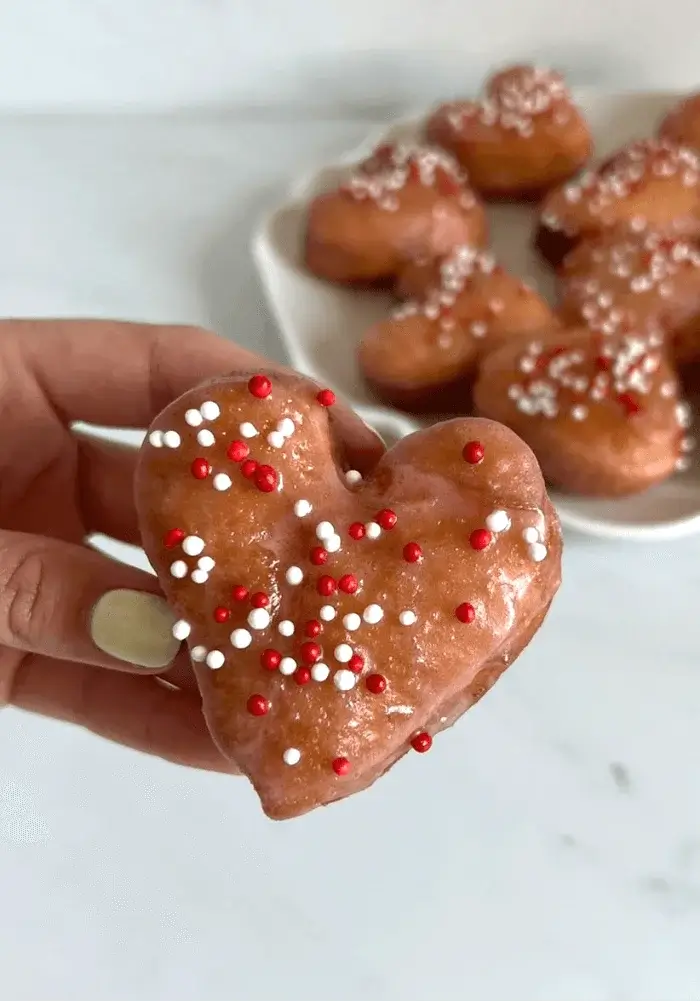
- Dip the donuts in the glaze or optional chocolate coating, decorate with sprinkles, and let set before serving.
FAQ
What is the best flour to use for making heart donuts?
The best flour is standard all-purpose flour, which provides a balance of structure and tenderness. All-purpose flour has enough protein to develop gluten for elasticity, which is crucial for a light, airy donut that holds its shape during frying. Using bread flour can make the donuts chewier, while cake flour may result in donuts that are too fragile and collapse easily.
It is also important to measure flour accurately, ideally by weight, to avoid dense dough. Sifting the flour before mixing can help distribute the yeast and sugar evenly, leading to more consistent proofing. For variations, some bakers incorporate a small portion of cake flour to increase softness, but standard all-purpose flour remains the most reliable for traditional heart donuts with a tender yet structured crumb.
How long should heart donuts be proofed before frying?
Heart donuts require two stages of proofing to achieve a light and airy texture. The first rise occurs after kneading the dough and lasts about 1½ hours at room temperature or overnight in the refrigerator. This allows the yeast to ferment, producing carbon dioxide that aerates the dough. After rolling and cutting the heart shapes, a second proofing of approximately 20 minutes allows the donuts to puff slightly and reach the correct volume before frying.
Underproofed donuts can be dense and heavy, while overproofed donuts may collapse when fried. The ideal visual cue is that the dough appears slightly puffed but still holds its shape. Temperature matters too: warm environments accelerate proofing, while colder settings slow it down, so monitor the dough carefully to ensure perfect heart donuts every time.
What oil temperature is best for frying the donuts?
The oil should be heated to approximately 320°F/160°C. At this temperature, the donuts cook evenly, forming a crisp outer layer while the interior remains tender and airy. If the oil is too hot, the outside browns too quickly, leaving the inside undercooked. If too cool, the donuts will absorb oil and become greasy.
Use a deep-frying thermometer for accuracy, and maintain consistent oil depth, about 2 to 3 inches/5 to 7.5 cm, to ensure even cooking. Fry donuts in small batches, allowing the oil temperature to recover between batches. Proper technique ensures heart donuts are perfectly golden, tender, and not oily.
Why do donuts sometimes collapse after frying?
This usually indicate overproofing, underproofing, or excessive handling before frying. Overproofed dough may have too much gas and lose structure when it hits the hot oil, while underproofed dough doesn’t have enough internal air, causing dense, heavy donuts that flatten.
Rolling the dough too thin or stretching it unevenly can also compromise structure. Frying at inconsistent oil temperatures can exacerbate the problem: too hot and the crust forms too fast, trapping steam and collapsing, too cool and donuts absorb excess oil and droop.
Can I use dry yeast instead of fresh yeast for heart donuts?
Typically, 1 tablespoon/20 grams fresh yeast equals about 2¼ teaspoons/7 grams active dry yeast. Active dry yeast should be dissolved in warm milk or water for 5–10 minutes before adding to the flour to ensure it activates properly.
This step ensures the heart donuts rise evenly and develop a tender crumb. Using dry yeast may result in slightly slower proofing compared with fresh yeast, so it is important to allow the dough to double in size fully during the first rise.
Why are my heart donuts dense or heavy?
The donuts can become dense if the dough is underproofed, overworked, or if the flour is measured incorrectly. Underproofing prevents the yeast from creating enough air pockets, resulting in heavy, tight donuts. Overworking the dough, especially after the first rise, can overdevelop gluten, making the texture chewy rather than soft.
Using too much flour, often from packing it into measuring cups, can also yield dense donuts. To avoid this, weigh your flour and handle the dough gently. Ensure the first proofing doubles the dough, and allow the heart-shaped cuts to puff slightly in the second proofing.
How can I prevent the glaze from running off the heart donuts?
Ensure the heart donuts are cooled slightly but still warm when dipping. The glaze should be thick but pourable, not watery, so it adheres evenly to the surface. Mixing powdered sugar with small amounts of milk gradually allows better control over consistency.
For colored glazes, use gel or oil-based food coloring to avoid thinning the glaze. Dipping only the top or using a spoon to coat precisely can help control coverage. Let the glazed heart donuts rest on a wire rack so excess glaze drips off and sets properly.
Can I make heart donuts without eggs?
Eggs provide moisture, richness, and contribute to the soft crumb and golden color. To replace one large egg, you can use ¼ cup/60 grams of unsweetened applesauce, mashed banana, or a commercial egg replacer. These substitutes add moisture while slightly altering the flavor, so mild options like applesauce are preferred to preserve the traditional donut taste.
Without eggs, the dough may require a slightly longer kneading time to develop gluten for elasticity. Proofing remains the same, and frying at 320°F/160°C ensures the heart donuts cook evenly and maintain a tender interior despite the egg replacement.

How can I bake the donuts instead of frying?
Preheat the oven to 375°F/190°C and lightly grease or line a sheet pan with parchment. Brush the heart donuts with melted butter or oil to help create a golden crust. Bake for 12–15 minutes, turning halfway, until the donuts are puffed and lightly golden. Keep in mind that baked donuts will not have the same deep-fried texture, and the interior may be slightly denser.
What causes uneven browning when frying donuts?
Uneven browning in donuts is often caused by inconsistent oil temperature, overcrowding, or improper dough thickness. Oil that is too hot can brown the exterior too quickly while leaving the inside undercooked. Conversely, oil that is too cool can make the donuts absorb excess oil and brown unevenly.
Frying too many donuts at once lowers the oil temperature, causing uneven cooking. Rolling the dough to an even thickness and ensuring uniform heart shapes helps all donuts cook at the same rate.
How long do heart donuts stay fresh, and can they be frozen?
Freshly made heart donuts are best enjoyed the same day, but they can stay fresh at room temperature in an airtight container for up to two days. Storing in the refrigerator is not recommended, as it can dry out the crumb and affect texture.
For longer storage, unglazed or lightly glazed heart donuts can be frozen in airtight containers or heavy-duty freezer bags for up to one month. Thaw at room temperature and reheat briefly in a warm oven to restore softness. Glazing after thawing ensures the coating remains glossy and intact.
Is it necessary to use vodka, arak, or brandy in heart donuts?
The addition of vodka, arak, or brandy in heart donuts is optional but improves texture. Alcohol inhibits gluten overdevelopment, resulting in a softer, lighter crumb. It also slightly tenderizes the dough and reduces oil absorption during frying, producing donuts that are less greasy while maintaining a delicate structure.
The flavor impact is minimal once fried, so it does not overpower the sweet glaze or optional chocolate coating. For those avoiding alcohol, the liquid can be replaced with an equal amount of milk, but the donuts may be slightly denser. Using vodka, arak, or brandy is a subtle technique to achieve light, airy heart donuts with an ideal texture.
How do I keep heart donuts from absorbing too much oil?
Maintain a consistent oil temperature of 320°F/160°C and fry in small batches to prevent temperature drops. Dough that is too wet or sticky absorbs oil more readily, so handle lightly and ensure proper proofing. Adding a small amount of alcohol, such as vodka, arak, or brandy, also helps limit oil absorption by weakening gluten slightly. Drain fried donuts on a wire rack rather than paper towels, which can cause sogginess.